

The Robin
He turned to me with a face I’d never seen before, twisted into something between mockery and malice.

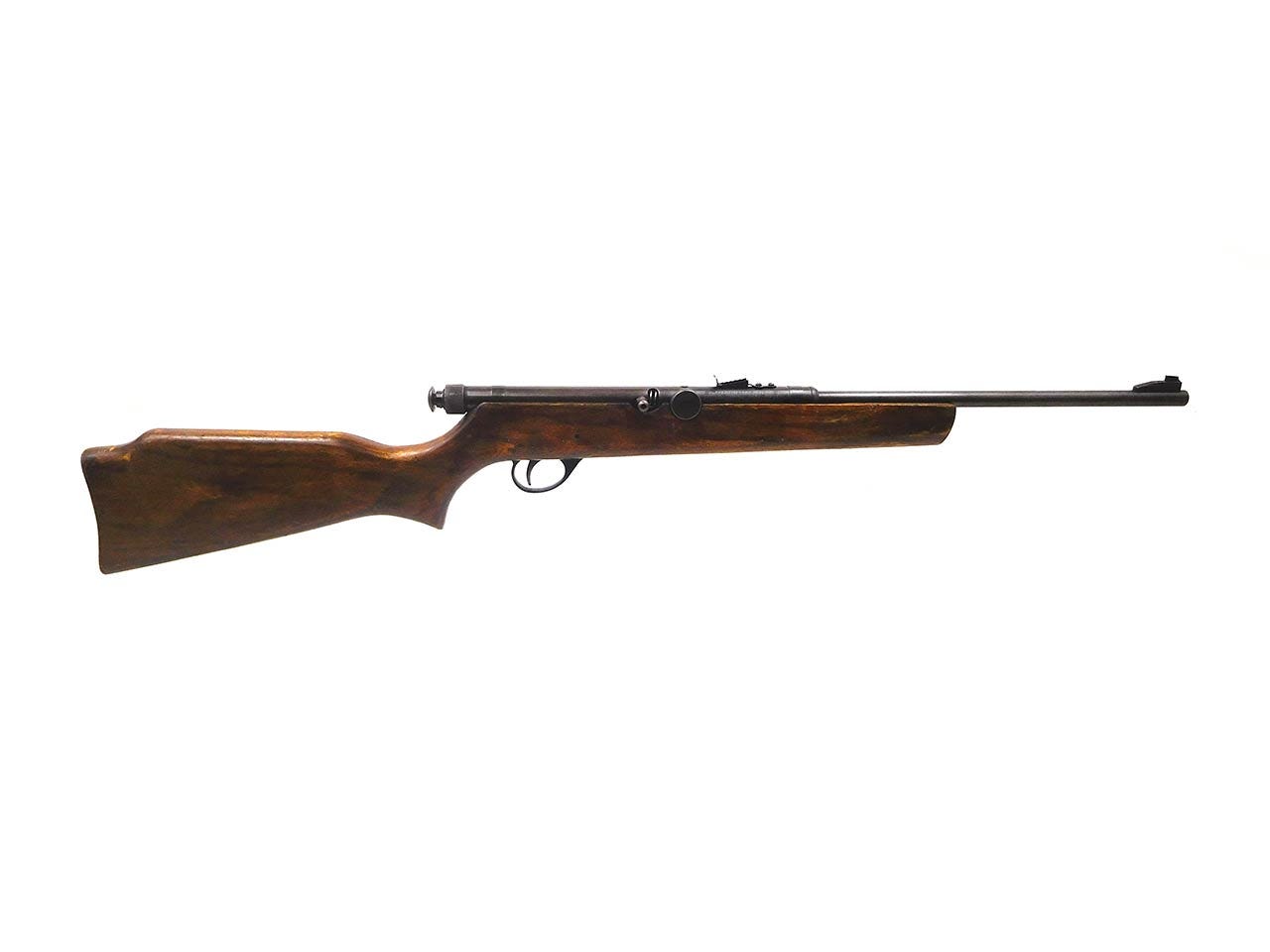
The Crossman 707 arrived on my twelfth birthday, its pump action smooth and heavy in my hands. I spent afternoons shooting cans off fence posts, watching them ping and tumble into the grass. The rifle made a satisfying crack with each shot, and I learned to gauge distance by the arc of the pellet through summer air.
One evening, a deer appeared at the edge of our property. She stood perfectly still, maybe thirty yards away, her dark eyes catching the last light. My finger found the trigger, but I couldn’t pump the rifle again. That mechanical sound would send her bounding into the trees. So I aimed with whatever pressure I’d already built, watching the pellet curve through space until it reached her, or near her. She startled and vanished. If it had touched her at all, it would have been nothing more than a tap, a reminder that she wasn’t alone.
My best friend’s family hunted. They had traditions passed down through generations, rituals I’d only heard about until the day they invited me to join them for dove season. His father handed me a shotgun that felt foreign and oversized. The men spread out across the field, and when the birds flew overhead, the air erupted with sound.
What I hadn’t understood was how it worked. The spray of pellets didn’t kill cleanly. It clipped wings, tore through feathers, brought the birds spiraling to earth where they lay broken but breathing. I watched my friend’s father demonstrate the mercy killing, a quick twist of the neck. Efficient. Practiced. Then my friend gathered five of the dead doves and slipped their severed heads onto his fingers like grotesque puppets.
He turned to me with a face I’d never seen before, twisted into something between mockery and malice. The heads bobbed as he wiggled his fingers, their small eyes glazed and vacant. Blood ran in thin lines down his wrists. When I looked away, his laughter followed me. The harder I tried not to see, the louder he laughed.
Years passed before that image surfaced again. I was in college, reading about the Terror, about crowds gathering to watch the guillotine do its work. That night, I dreamed of executioners’ assistants collecting the heads, but in my dream the victims were tiny, their heads just the right size to fit on fingertips. The assistants wore my friend’s face as they displayed their trophies to the cheering mob.
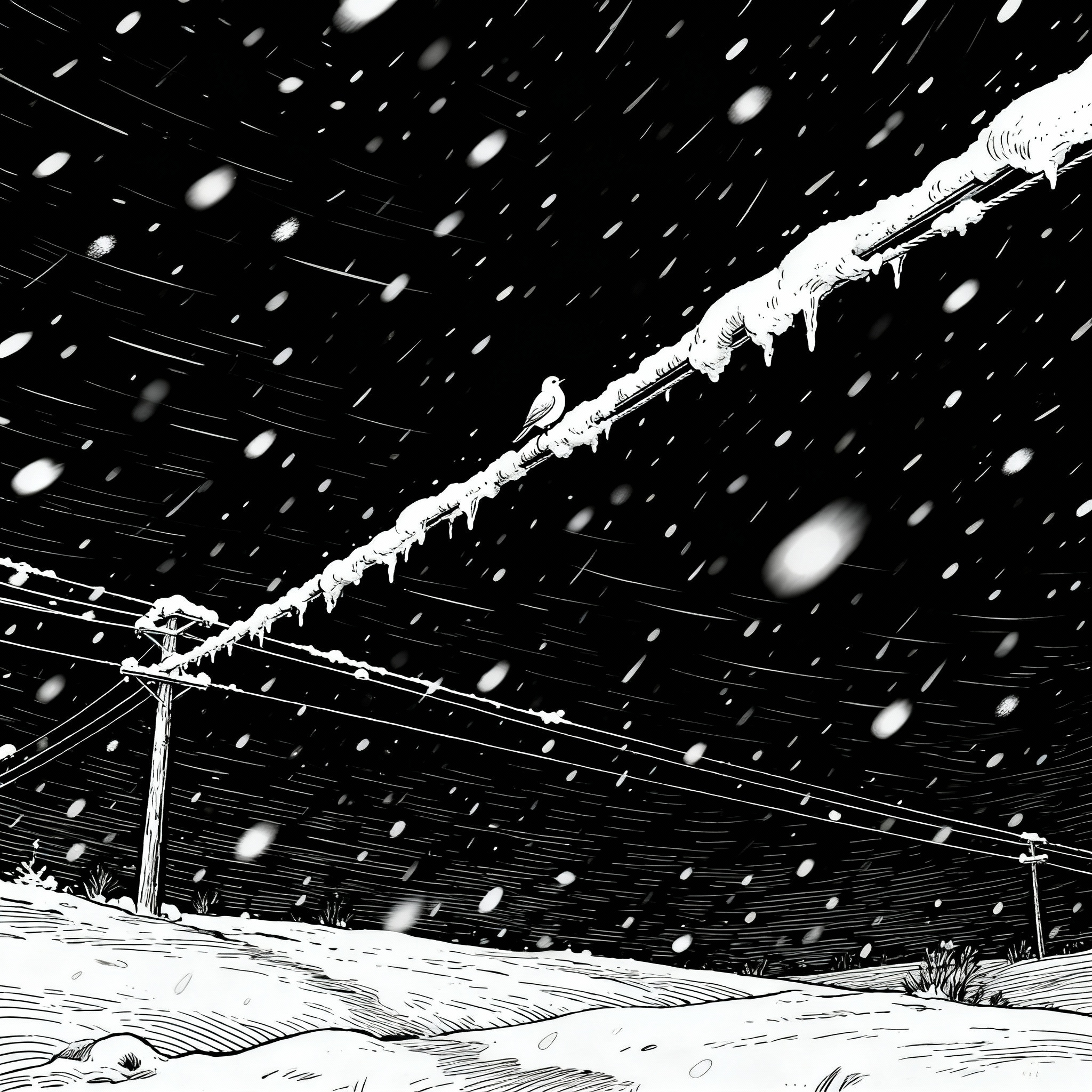
Winter came early that year, the first snow falling thick and wet. I pumped the rifle twenty times, feeling the resistance build with each stroke, then loaded a single pellet. Through the curtain of white, I could make out the power line stretched across our yard and a small bird perched there, feathers ruffled against the cold.
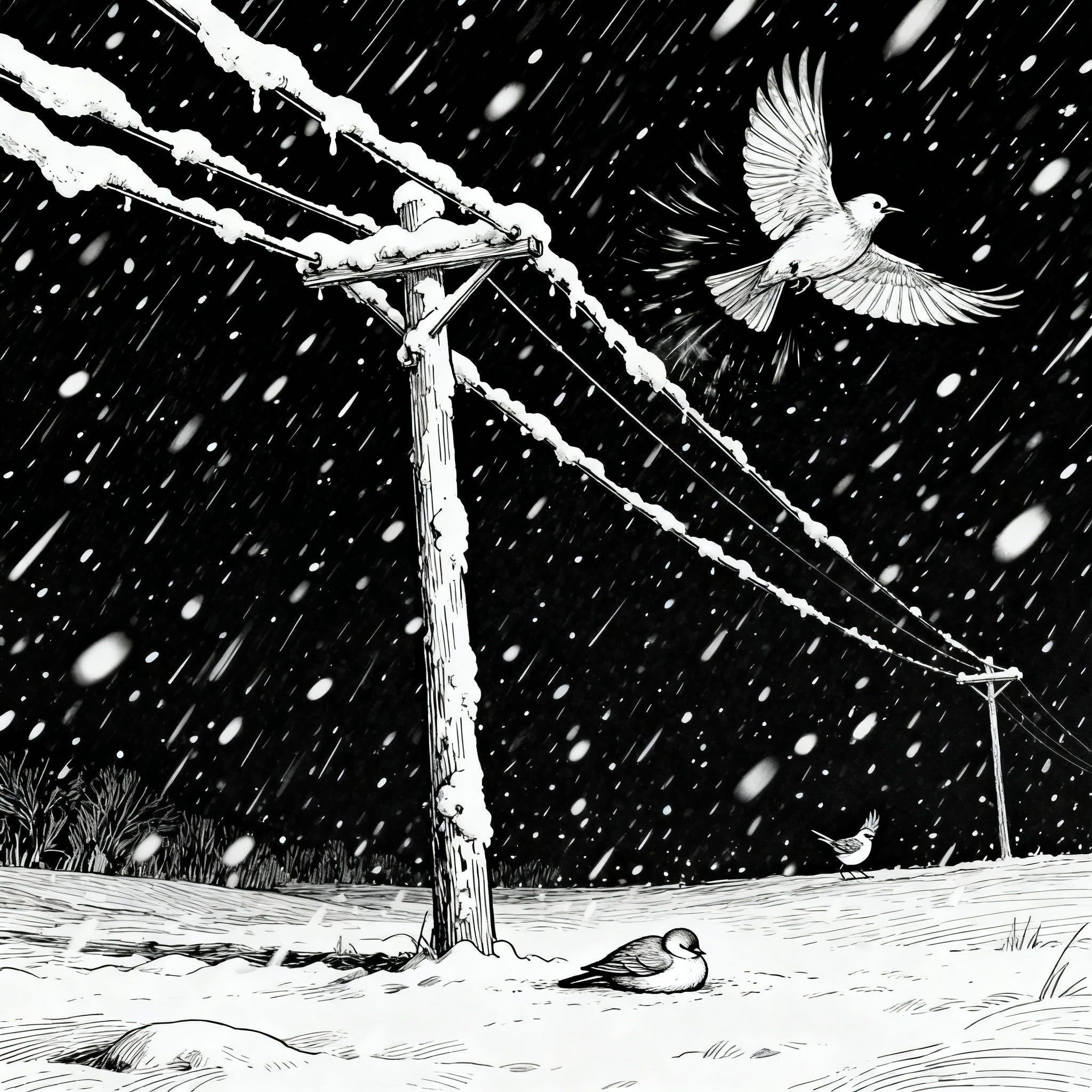
The shot was clean. The silhouette simply dropped, disappearing into the accumulating snow. But as I walked closer, something else emerged from the white, a second bird, a robin, circling frantically above where the first had fallen.
She dove and rose, dove and rose, her red breast heaving with effort or panic. Her cries cut through the muffled silence of the snowfall. When she landed beside the still form, she pecked gently at the matching red breast, as if the right touch might wake him. She hopped in circles around the body, returning again and again to nudge him with her beak.
Did she see me standing there? I don’t think so. Her world had narrowed to this inexplicable stillness, this sudden absence. One moment her mate had been beside her, weathering the storm. The next, he was gone, and she couldn’t understand why he wouldn’t respond to her increasingly desperate calls.
I stood in the falling snow, watching her grief play out in movements both frantic and tender. She’d fly a small circle, return to his side, call out, peck at his breast, then launch into the air again. Each loop seemed to carry the hope that this time would be different, that this time he’d stir and follow.
The memory that haunts me isn’t the dove hunt, though those images remain sharp enough. It isn’t even my friend’s grotesque display, though I can still see his face twisted in that terrible grin. What stays with me is that robin in the snow, circling her dead mate with a persistence that looked too much like human grief.
She couldn’t know what had happened. Death had come from nowhere, invisible and instant. All she knew was that something fundamental had broken in her world, and no amount of circling or calling could repair it. I think about her confusion, her helplessness, the way she kept returning to touch his still-warm body as snow began to cover them both.
That was the last time I held a gun. The rifle went into the closet and stayed there, eventually disappearing in some garage sale or donation. My friend and I drifted apart through high school, our paths diverging in ways that felt inevitable even then. He probably still hunts with his father, teaching his own children the old rituals.
But I think about that robin. I think about how grief looks the same across species, how loss registers in the body as circling, searching, returning to the place where love used to be. I think about her in that snow, unable to comprehend why her constant companion had suddenly become so terribly still.
Sometimes I wonder if she understood eventually, if robins can process death the way we do. Or if she simply circled until exhaustion or cold drove her to shelter, returning the next day to find only snow where he had been. The not knowing feels worse somehow than the knowing.
We tell ourselves that death in nature is quick and purposeful. But I remember those doves struggling in the dirt, necks twisted at unnatural angles. I remember my friend’s bloody fingers and his father’s practiced efficiency. Most of all, I remember how long that robin circled in the snow, how her cries grew as the light faded.
There’s no clean ending to this story, no moment of redemption or understanding. Just a boy with a gun, a bird in the snow, and another bird who couldn’t accept what she was seeing. Just the weight of watching grief unfold in real time, knowing you’re the author of it, knowing there’s no gesture that can undo what’s been done.
The violence wasn’t in the shooting. It was in the watching afterward, in seeing how death ripples outward, touching lives I hadn’t considered. It was in learning that every creature we end leaves someone circling in the snow, calling out to silence, pressing their breast against the absence where warmth used to be.