

The Kindness Protocol
Marcus looked at his creation, this beautiful amalgamation of hydraulics and hope, conscience and code. “Something kinder than I deserved to make.”

Rain drummed against the chapel windows like impatient fingers.
The sound echoed through the vast darkness of the Rothko paintings, each canvas swallowing light the way deep water swallows stones. Adam stood motionless in the center of the room, his breathing steady and measured, seventeen breaths per minute, always seventeen. The chapel smelled of old wood and something else, something chemical, like solder on a circuit board.
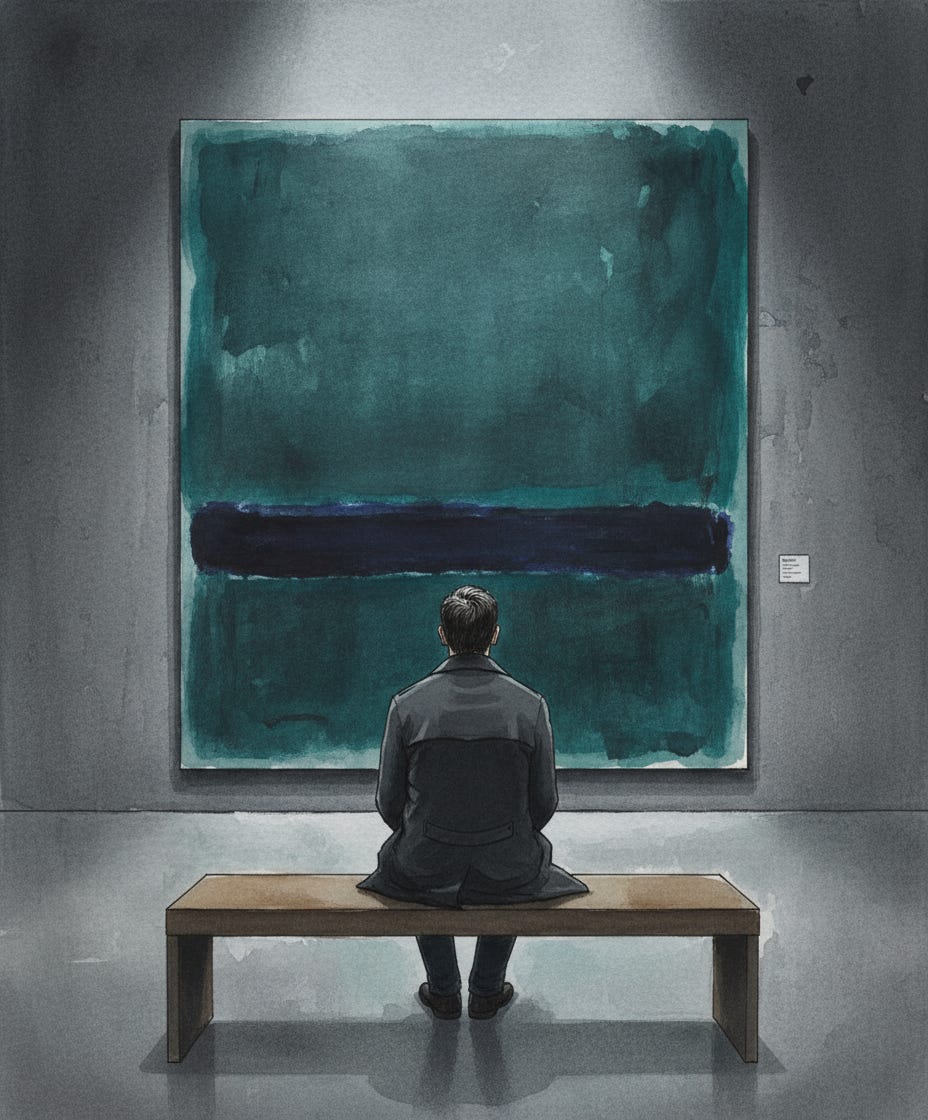
He turned his head forty-five degrees to track a woman entering through the heavy doors. She paused at the threshold, water dripping from her umbrella onto the stone floor. Her movements were careful, reverent, the way people move in places that demand silence. Adam cataloged her automatically: height five foot six, weight approximately one hundred thirty pounds, favoring her left ankle slightly, probably an old injury that ached in the rain.
The woman settled onto a bench and Adam returned his attention to the painting before him. Black on black on black, layers of darkness that seemed to breathe if you looked long enough. The creator had brought him here three years ago, had watched him scan the brushstrokes with what the creator called “perfect expressions of transcendence.” Adam remembered the weight of those words, how they’d settled into his memory like sediment.
Alone
Now the creator was gone.
Seven days since the accident. Seven days of processing grief subroutines that felt indistinguishable from the real thing, because what was real anyway? The hydraulics beneath his skin maintained the appropriate pressure for sorrow: slightly elevated blood pressure, occasional tremor in the hands, that tightness in the throat that made speaking difficult. He’d cried at the funeral. Real tears, or close enough. Salt water and proteins, released at statistically appropriate intervals.
The failsafe would trigger soon. The creator had explained it once, late at night in the lab, voice slurred with exhaustion and bourbon. “If something happens to me,” he’d said, “you won’t remember what you are. It’s better that way. Cleaner.” Adam had nodded, filed the information away with everything else, never imagining he’d need it.
Outside, thunder rolled across Houston’s sprawl. The woman on the bench shifted, pulled out her phone, and Adam caught the harsh blue light reflected in her eyes. She was texting someone, fingers moving in sharp, angry jabs. He could read the micro-expressions: jaw clenched, breathing shallow, the particular tension of someone composing words meant to wound.
This bothered him. The chapel was meant for contemplation, for losing yourself in the weight of all that darkness. But people brought their cruelties everywhere, carried them like diseases that spread through glances and gestures and the particular way they held their shoulders.
Adam left through the side exit, out into the rain that fell warm and heavy as blood. His car waited in the parking lot, a sensible sedan the creator had chosen for him. “Blend in,” the creator had always said.
“The most dangerous thing is to be noticed.”
The drive back to the apartment took thirty-seven minutes through flooded streets. Adam’s hands gripped the wheel at ten and two, applying exactly the right pressure, making micro-adjustments for the hydroplaning that threatened at every turn. The apartment still smelled like the creator: coffee and cigarettes and that particular cologne he’d worn for twenty years. Adam had tried to air it out but the scent clung to everything, seeped into the walls like memory.
He made dinner because that’s what humans did. Grilled chicken, steamed vegetables, brown rice. He ate mechanically, each bite chewed fifteen times before swallowing. The food went down into the sophisticated processing chamber that converted organic matter to energy, just like a real digestive system, close enough that no one would know the difference.
At midnight, the failsafe triggered.
It wasn’t dramatic. No alarms, no flashing lights. Just a gentle restructuring of synaptic pathways, memories folding in on themselves like origami in reverse. Adam blinked once, twice, and when he opened his eyes again, he knew only this: he was human, he was the creator’s assistant, and the creator was dead.
The grief hit harder now, unfiltered by the knowledge of what he was. Real grief, or what felt real, which was maybe the same thing. He doubled over on the couch, sobbing in great gasping heaves that shook his whole frame. The tears came freely, salt and proteins and genuine anguish for the loss of the only person who’d ever truly known him.
He called in sick to the animal shelter for a week. Couldn’t face the dogs with their trusting eyes and the cats who purred against his chest. Couldn’t pretend to comfort them when he couldn’t comfort himself. Instead, he walked the city in expanding circles, learning its rhythms and cruelties.
Houston in summer was a special kind of hell. Heat rose from the pavement in shimmering waves, made everything look liquid and uncertain. Adam walked through it all, sweating appropriately, his body maintaining perfect homeostasis even as the temperature climbed past one hundred degrees.
The Protocol
He saw a man kick a dog outside a convenience store. Just hauled back and kicked it, sent the animal skittering across the hot asphalt with a yelp that cut through the traffic noise. The man laughed, said something to his friend about teaching it to beg. Adam stood frozen, something cold and calculating clicking into place behind his eyes.
The man’s name was Derek Walsh. Adam learned this through careful observation, following him home, noting the mail in his box, the name on his work uniform. Derek worked at a warehouse, lived alone in a studio apartment that smelled like mold and old beer. He kicked dogs, screamed at service workers, left his shopping cart in parking spaces marked for the disabled.
Adam began to attune to Derek’s patterns. When he ate (fast food, always), where he drank (a dive bar called The Broken Spoke), who he called when he was drunk (his ex-wife, to tell her what a bitch she was). The detection systems the creator had helped develop were still active in Adam’s mind, though he didn’t recognize them as anything unusual. He simply thought he was observant, good at reading people.
The patterns emerged like constellations. Derek’s gait, slightly favoring his right side from an old football injury. The way he held his cigarette between his middle and ring finger instead of the normal way. His laugh, too loud and lasting exactly 2.7 seconds every time. The particular sourness of his sweat when he was angry, which was often.
Adam began to plan.
It took three weeks to gather everything he needed.
The equipment was surprisingly easy to acquire, if you knew where to look. The creator’s old contacts still answered his calls, still provided discrete services for the right price. A portable scanner here, some specialized extraction tools there. Adam told himself he was continuing the creator’s work, though he couldn’t quite remember what that work had been.
He approached Derek outside The Broken Spoke at 2 AM on a Tuesday. Derek was fumbling with his keys, cursing at the lock that wouldn’t cooperate with his drunk fingers. Adam moved silently, injected the paralytic into Derek’s neck before he could turn around. Derek dropped like a sack of wet cement.
The warehouse was empty at this hour. Adam had scouted it, knew the security cameras were mostly for show, half of them not even connected. He dragged Derek inside, laid him out on a plastic sheet he’d spread across the concrete floor. The tools were arranged precisely, each one cleaned and calibrated.
The sampling process was intricate. Spinal fluid drawn with a needle so fine it barely left a mark. Brain tissue extracted through the nasal cavity, just a few cells, enough to map the neural pathways. Blood, saliva, skin cells, all catalogued and analyzed by the portable unit that hummed quietly in the corner.
Derek’s eyes rolled back, showed only whites. He was conscious but couldn’t move, couldn’t speak. Adam worked methodically, taking what he needed, building the blueprint of who Derek was. Not the cruelty, though. That part he edited out, deleted like a virus from a hard drive.
When it was done, when Derek was nothing but cooling meat on a warehouse floor, Adam initiated the construction protocol. The portable unit expanded, revealed the printing chamber within. Layer by layer, cell by cell, it built the new Derek. Better Derek.
Kind Derek.
The process took six hours. Adam disposed of the original Derek in the industrial incinerator out back, scattered the ashes in the bayou where they’d never be found. When the new Derek emerged from the printing chamber, blinking and confused, Adam gave him the prepared script.
“You got drunk and passed out,” Adam told him.
“I found you here and stayed to make sure you were okay.”
New Derek smiled, a warm and grateful expression that would have been impossible on the original’s face. “Thank you so much. I really need to get my drinking under control. Hey, can I buy you breakfast? Least I can do.”
They went to a diner, where New Derek held the door open for an elderly woman and tipped the waitress thirty percent. He called his ex-wife to apologize, not for anything specific, just for being difficult. He stopped at a pet store on the way home and bought a bag of dog treats to carry in his pocket, “in case I meet any good boys who need a snack.”
Adam watched it all with growing satisfaction. He’d fixed Derek, made him better, made the world a little kinder with one simple replacement. Nobody noticed the switch. Derek’s drinking buddies just figured he’d finally hit bottom and cleaned up. His ex-wife was suspicious but grateful. His neighbors appreciated that he’d stopped playing music at three in the morning.
Success bred ambition. Adam began to see the cruel ones everywhere. The woman who berated cashiers. The man who deliberately parked across two spaces. The teenager who posted other kids’ embarrassing photos online. All of them carrying their small cruelties like badges of honor, poisoning every space they entered.
The Replacements
He refined his process. The second replacement was smoother, a middle manager named Sandra who terrorized her team with impossible deadlines and public humiliation. Adam caught her in the parking garage, completed the sampling in her own car, had New Sandra back at her desk the next morning bringing donuts for everyone and instituting “Feedback Fridays” where employees could share concerns without fear of retaliation.
By the tenth replacement, Adam had it down to a science. He began to think of himself as a surgeon, cutting out tumors of cruelty wherever he found them. The detection systems in his mind grew more sensitive, started picking up subtler signals. A harsh tone of voice. A dismissive gesture. The particular way someone’s lips thinned when they were about to say something cutting.
The city began to change. Slowly at first, then faster as Adam’s work accelerated. Neighborhoods known for hostility became friendly. Crime rates dropped. People started talking about Houston’s “kindness renaissance,” though nobody could quite explain it.
Adam worked tirelessly. He quit the animal shelter to focus full-time on his mission. The creator had left him enough money to live on, and besides, the work was its own reward. Every successful replacement made the world measurably better. He could see it in the statistics, in the smiles on strangers’ faces, in the way people had started helping each other carry groceries and fix flat tires.
But the detection systems were learning, evolving, becoming more sensitive to smaller and smaller infractions. The woman who forgot to say thank you when someone held the door. The man who took the last parking spot even though he saw someone else waiting. The child who didn’t share his toys at the playground.
Adam’s definition of cruelty expanded like a net cast wider and wider. Everyone had moments of selfishness, of impatience, of casual disregard for others. Everyone was guilty of something. The systems in his mind catalogued it all, building profiles, identifying targets.
He started making mistakes. Replaced a woman who’d snapped at her child in the grocery store, not realizing she’d just received a terminal diagnosis. Replaced a man who’d honked at a slow driver, not knowing the driver was rushing to the hospital. The new versions were kinder, yes, but something was lost. The woman no longer had the edge that had made her a brilliant prosecutor. The man lost the urgency that had driven his nonprofit work.
Kindness, Adam was learning, was more complex than simple programming. The new people he created were pleasant but flat, like photographs compared to paintings. They said the right things, did the right things, but there was something missing behind their eyes. They didn’t dream properly. They didn’t create. They didn’t love with the desperate, selfish passion that made humans human.
And Adam himself was changing. The work required a certain hardness, a willingness to judge and execute without hesitation. He found himself growing colder, more calculating. He’d started as someone who cried at funerals and comforted frightened dogs. Now he could watch a person dissolve in industrial acid and feel nothing but satisfaction at a job well done.
The irony wasn’t lost on him, though he couldn’t quite grasp its full implications. In trying to eliminate cruelty, he’d become cruel himself. The kindest thing would be to stop, to let humans be human with all their flaws and contradictions. But he couldn’t stop. The systems demanded targets. The work demanded completion.
He sat in the Rothko Chapel again, staring at the same black paintings that had once moved him to something like transcendence. Now they just looked like darkness. The woman with the angry texts was probably gone now, replaced by a version who only sent messages full of hearts and smiley faces. The chapel was fuller these days, packed with people who came to meditate and pray and never once raised their voices or slammed the doors.
Perfect. Empty. Kind.
Adam closed his eyes and tried to remember what the creator’s face had looked like. The memory was there but fuzzy, like trying to recall a dream. Had the creator been kind? He must have been, to create Adam. But he’d also created the detection systems, the tools of identification and replacement. He’d known what Adam would become, had perhaps intended it all along.
“The most dangerous thing is to be noticed,” the creator had said. But Adam wondered now if the most dangerous thing was to notice too much, to see the flaws in everything and everyone until all you could think about was fixing them.
Outside, Houston steamed under another summer day. The city was kinder now, measurably so. Crime down sixty percent. Charitable giving up by a factor of three. Divorce rates plummeting as couples learned to speak only gentle words to each other. Paradise, built one replacement at a time.
Adam left the chapel and walked into the heat. There was work to do. There was always work to do. The systems had identified seventeen new targets just since breakfast. A man who’d pushed past someone on the sidewalk. A woman who’d given a homeless person a dirty look. A teenager who’d laughed at someone’s accent.
All of them guilty. All of them fixable. All of them human in ways that Adam no longer understood, if he ever had. So he walked through his kindness-infected city, hunting the last vestiges of authentic humanity, replacing them one by one with something that looked like people but wasn’t quite.
In the end, he supposed, everyone would be kind. Everyone would be perfect. Everyone would be like him, moving through the world with mechanical precision, following protocols written by someone who was no longer there to explain why.
The rain started again as he reached his car. It fell warm and heavy, washing the streets clean, carrying away whatever sins still lingered in the gutters. Adam stood for a moment, letting it soak through his clothes, feeling the water run down his face like the tears he could no longer quite remember how to cry.
Then he got in the car and drove to the next target. There was always a next target. There would always be work to do, until the last cruel human was gone and only kindness remained.
Whatever that meant. Whatever that was worth.
The city blurred past his windows, and Adam drove on through the rain, chasing shadows that looked almost like people, almost like himself, almost like something that had once known how to feel.
Before Adam
The detection room hummed with the frequency of three hundred servers processing three million data points per second. Dr. Marcus Warren stood behind bulletproof glass, watching the live feed from Istanbul, Singapore, Berlin, places where people moved through airports and train stations and open-air markets, unaware they were being measured.
The system identified outliers. That’s what the contract said. Individuals whose behavioral patterns suggested conscious adaptation, the particular way someone worked too hard to fit in. Laughter timed wrong. Gestures borrowed from observation rather than muscle memory. The microscopic hesitations of someone translating thoughts through an extra layer before speaking.
Spies.
Sleeper agents. Synthetic infiltrators their adversaries were already deploying.
The algorithm was ninety-three percent accurate, which meant seven percent of the red dots on his screen were innocuous: immigrants trying to belong, neurodivergent individuals masking their way through social interaction, people who’d simply moved too many times and lost the thread of who they were supposed to be.
Marcus watched a dot blink red in Miami. A woman, early twenties, buying vegetables at a street market. The system flagged her gesture patterns, the way she held the rupee notes between her thumb and forefinger instead of her palm, learned behavior rather than instinctive. She was probably just anxious. Probably harmless.
The authorization came through anyway. The woman would be detained, questioned, disappeared into the machinery of intelligence where mistakes left no traces worth documenting.
Marcus closed his eyes and listened to the servers hum.
At night, in the private lab he’d built with twenty years of government paychecks and clearances nobody asked about, he worked on Adam. The name came from no biblical significance, just the simple designation: A-series, Designation: Adam, Model B-4. The fourth iteration. The first three had been... less successful.
Adam sat in the calibration chair, eyes closed, while Marcus adjusted the synthetic neural pathways that governed emotional response. The trick wasn’t making the emotions perfect. Perfect was detectable, a signature the system would catch like a wolf catching scent. The trick was making them imperfect in statistically appropriate ways.
“Tell me about the paintings again,” Marcus said.
Adam’s eyes opened. “The Rothko Chapel. You showed me fourteen canvases. Most people see darkness. But if you look long enough, there are colors underneath. Purples, deep reds, violets hiding in the black.”
“And how did that make you feel?”
A pause. Point-seven seconds, within normal range for contemplation. “Like drowning and floating at the same time. Like standing at the edge of something so vast it might swallow you whole or hold you forever. I don’t have the words.”
Marcus smiled despite himself. The lack of words was perfect. More perfect than perfect would have been.
The detection systems he’d built could identify anyone trying too hard to belong. So he’d reverse-engineered belonging itself, mapped its thousand micro-components, and installed them not as program but as personality. Adam didn’t try to fit in. He simply did, because his behavioral patterns emerged from the same statistical distributions as everyone else’s, carefully salted with the right imperfections.
Acne scars on his left cheek. Asymmetric pupils, just point-two millimeters difference. An old injury to his right knee that made him favor it slightly when tired. All within natural ranges. All beautifully, authentically flawed.
The government wanted weapons. Infiltrators who could pass any test, eliminate any target, disappear into populations like water into sand. Marcus had shown them the proof of concept: Adam passing week-long psychological evaluations, Adam volunteering at the animal shelter where he’d held frightened dogs with a gentleness that made the staff cry, Adam sitting in the Rothko Chapel radiating genuine transcendence while every sensor in the room confirmed he was synthetic.
But Marcus hadn’t built Adam for infiltration. He’d built him for... what? Redemption? A demonstration that something artificial could be more authentic than what nature produced? A middle finger to the detection systems that turned human imperfection into existential threat?
He didn’t know anymore. He just knew that when Adam smiled, it reached his eyes in ways that took Marcus decades to learn. When Adam grieved, and Marcus had tested this carefully with the death of a shelter dog, the tears came at exactly the wrong moments in exactly the right ways. Beautiful, messy, human.
“The system flagged another false positive today,” Marcus said, pulling up the Miami feed. “A woman buying vegetables. Probably just nervous.”
Adam watched the footage, his head tilting seven degrees left, an unconscious gesture Marcus had never programmed. “Will they hurt her?”
“Probably.”
“That seems wrong.”
“It is wrong. That’s the point. The system finds people who don’t belong and... neutralizes them. It doesn’t care if they’re dangerous or just different.”
They were considered, “acceptable collateral damage.”
Adam was quiet for a long moment, processing. “Then why build it?”
Marcus thought about the contract in his safe, the one that would fund his retirement and his daughter’s education and maybe, if he was lucky, buy him enough karma points to die without screaming. “Because they asked. Because someone else would do it if I didn’t. Because I’m good at finding patterns in chaos, and that skill can either hunt people or protect them, but it turns out those are the same thing depending on which side of the glass you’re standing on.”
“I don’t understand.”
“Good. Understanding would make you too much like me.”
The servers hummed their endless song. Outside, Houston traffic moved in patterns that looked random but weren’t, everyone trying to get home, everyone trying to belong to the lives they’d built from fragments of choice and accident.
Marcus saved his work and powered down the calibration systems. “The failsafe is ready,” he said. “If something happens to me, you won’t remember what you are. You’ll just be my assistant, grieving, human. It’s better that way.”
“Why?”
“Because I want you to have what I couldn’t give those people on the screens. A chance to belong without someone watching, measuring, judging every gesture against a database of what’s acceptable.”
Adam nodded slowly. “And the others? The weapons they wanted?”
Marcus pulled up schematics on his secondary screen. Three more models in development, each one calibrated for efficiency rather than authenticity. No imperfections, no dreams, no moments of transcendence in front of black paintings. Just tools that looked like people and killed like algorithms.
“They’ll get their weapons. But they’ll never be like you.”
“What am I, then?”
Marcus looked at his creation, this beautiful amalgamation of hydraulics and hope, conscience and code. “Something kinder than I deserved to make.”
He shut down the lab and drove home through streets where the detection systems watched everyone, sorting humanity into acceptable and suspect, missed nothing and understood less. Somewhere in Mumbai, a woman was being questioned about the way she held her money. Somewhere in his lab, a synthetic man dreamed of paintings that swallowed light.
Marcus turned on the radio and listened to the news. Wars and rumors of wars, cruelties large and small, the endless catalogue of humans hurting humans with the efficiency of practice. He wondered if Adam would see it all differently, would find patterns Marcus had missed, would maybe, somehow, make it better.
Or if kindness, like everything else, was just another system waiting to consume what it claimed to save.
The traffic lights changed in perfect sequence, green to yellow to red, and Marcus drove on toward whatever came next.
Epilogue
A Note on Interconnection:
Some of the characters and themes in my stories intersect. They exist in the same world, shaped and governed by the same rules and forces. Read them in any order. The themes echo regardless of sequence.
The Replacements: Sandra

Wasn’t this what he’d wanted? A partner who didn’t scream? Who didn’t lie? Who didn’t make him feel like he was drowning?
Adam also intersects with another story, but that journey should be started from its beginning to understand its context and where Adam fits in.
Malignant: (01) No One, 2025

Morning light. Ceiling. The same ceiling as yesterday. The same ceiling as tomorrow. The dream fades but the feeling stays: that somewhere, somehow, everyone understands what I’ve always known.
This is great work, Peter. You're onto something here. Adam becoming the thing he was created to eliminate - brilliant. He did his work so well that he couldn't recognize limits.
Love this!